I Spent Thousands on Boosters, Energy Drinks and Supplements… So Why Was I Still Waking Up Exhausted, Crashing by 3 PM and Losing My Bedroom Confidence?

I thought I was getting older. I blamed stress, work and everything else. But after spending my hard-earned money chasing temporary fixes, I discovered that I might have been looking in the wrong direction all along. And what I learned about the connection between my daily energy, my body’s natural systems and my bedroom confidence changed the way I approached my health.
You know the moment. It’s 3:12 on a Wednesday afternoon. You had a decent lunch. You slept a full night. But your eyes are heavy, your mind feels wrapped in cloth, and you’re already thinking about a cold energy drink just to push through the next two hours.
I know that moment, because for years it was mine. And like most men, I did what felt like taking action: I bought the boosters, the energy drinks, the supplements — one temporary fix after another, every time hoping this would be the one.
Nothing lasted. And somewhere in the back of my mind I knew why: I was treating a symptom I couldn’t even name. A few years earlier I hadn’t been like this — and some men around me, sometimes older, seemed completely untouched by it.
What finally turned me in a new direction was the emails I started getting from newsletter readers stuck exactly where I had been. One of them is the story I’m about to tell you. I’ve seen it in slightly different versions — in my inbox, on Nigerian forums, in WhatsApp groups at 2 AM. The names change. The city changes. The night changes. But the shape of the night is always the same.
01 A Story from Port Harcourt
Names changed. The night didn’t.
A man I’ll call Emeka — a composite of several newsletter readers who have written to me, details changed to protect them — emailed me late one Tuesday evening last year. He is 41. He works in oil services. He is married, has two children, and is one of those men who handles things himself. He doesn’t complain. He doesn’t ask for help.
He wrote that something had gone wrong in the bedroom a few weeks earlier. Not catastrophic. Not the worst night of his life. But something had shifted.

He described the moment he would end up trying to forget for the next six weeks. It wasn’t the difficulty itself. It was the way his wife looked at him afterward — a face he described as somewhere between disappointment and concern. And maybe, he admitted, in a line he had clearly rewritten more than once, something closer to worry.
“I felt like I had failed her,” he wrote. “And worse — I felt like I couldn’t tell anyone. Not even her. Especially not her.”
The way she looked at him afterward.
For six weeks, he tried to fix it quietly, alone. He did what most Nigerian men do: he bought a bottle of something from a market stall. He ordered a supplement from an Instagram ad. He briefly considered a kiosk pill a colleague at work casually mentioned.
When he finally wrote to me, he described his six weeks in one sentence that I still think about: “I don’t feel like I have to prove anything to my wife anymore. I just feel like I’ve been defeated by something I can’t name.”
02 The Question I Want You to Sit With
What would you have done?
Before I tell you what actually helped Emeka — and why the fix was the last thing any man would have guessed — I want you to think about what you would have done in his position.
Don’t read this thinking about him. Think about yourself. Imagine it’s your Tuesday night. Imagine the face. Which of the four options below would you have gone with?
“Something goes wrong in the bedroom tonight. What do you do next?”
Be honest with yourself. Pick the one answer that feels most like what you would have chosen.
Buy a bottle of the strong stuff.
The unlabeled bitters from the market. The one that “works fast.” The one your colleague swears by.
Try the blue pills from a kiosk.
You’ve heard what they do. The pharmacy version costs too much. A friend mentions he knows where to get them.
Order a “testosterone booster” online.
The ads say it doubles your manhood. Feels scientific. Feels modern. Feels like the man’s version of taking action.
Pause and think about your body as a system.
Not about the night. About the last six months. Sleep, food, stress, movement, water. The unglamorous stuff.
03 The Verdict
Three of those four answers will make it worse.
Here’s the uncomfortable part. Answer D is the only correct one — and it’s the one almost no man picks first. Let me walk you through why each wrong answer is worse than it sounds.
The roadside bottle.
It might feel like it works — for a night or two. But unlabeled “strong” bitters have no dose, no ingredient list and no testing.

Products like these have been found elsewhere to contain heavy metals (lead, mercury, arsenic), undeclared prescription drugs (sildenafil and similar), and herb combinations that have never been studied together. The ones that “work” fastest are often the ones with a hidden pharmaceutical inside, at an unknown dose. And doctors across Nigeria have raised concerns about kidney and liver strain from unregulated herbal mixtures taken for months without any testing.
The kiosk blue pill.
Sildenafil genuinely works — prescribed by a real doctor, at a verified dose, for a man who is not on certain heart or blood-pressure medication. But the WHO estimates that roughly 1 in 10 medical products in low- and middle-income countries is substandard or falsified, and unlicensed sellers are where that risk concentrates. A kiosk pill can be the wrong drug, the wrong dose, or filler.
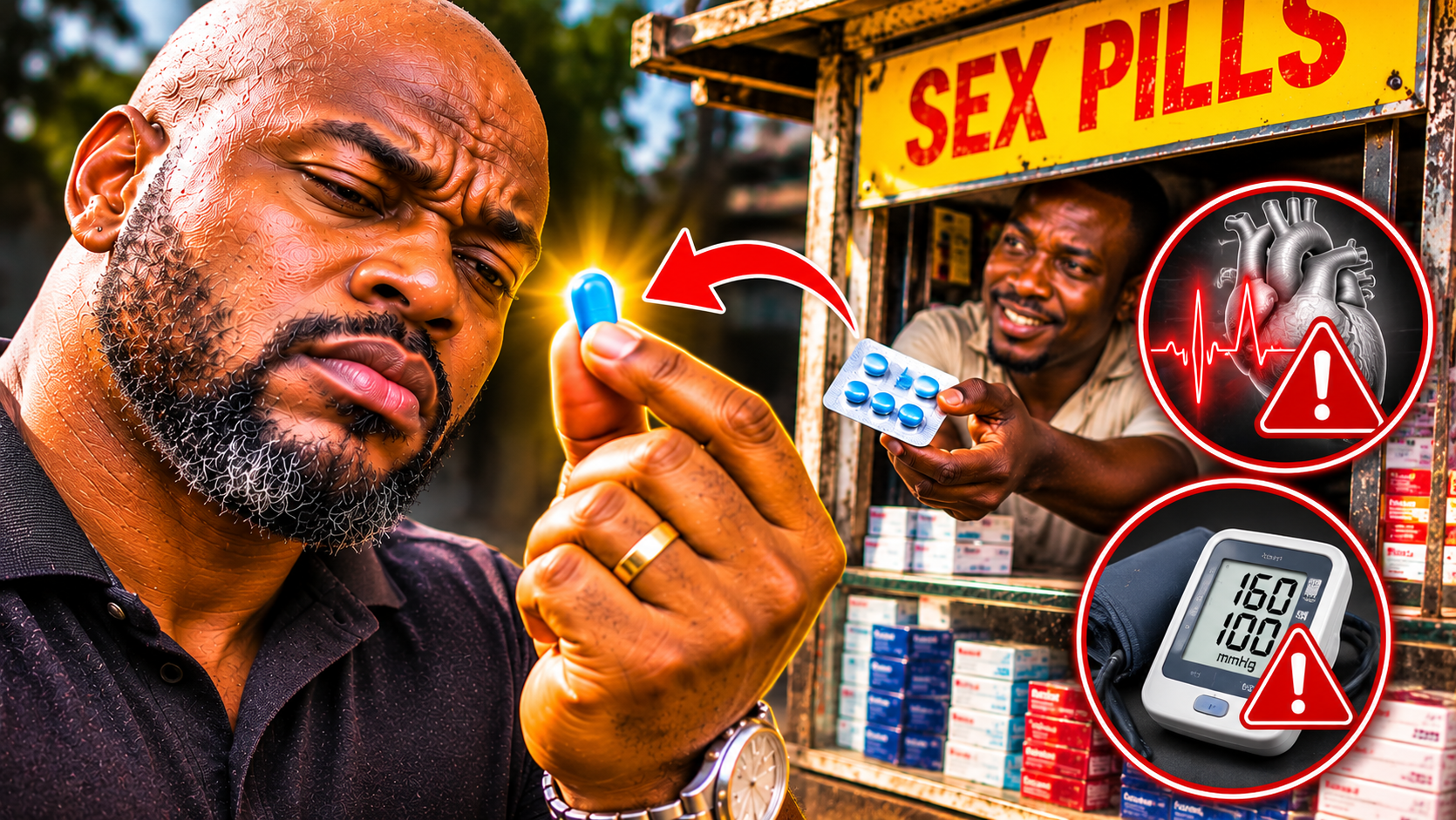
And if you take nitrate or blood-pressure medication (many Nigerian men over 40 quietly do), mixing it with sildenafil can be dangerous.
The “testosterone booster.”
This one feels scientific. It’s not. Most men who feel like Emeka — tired, foggy, quietly failing at night — do not have low testosterone. A small percentage do.
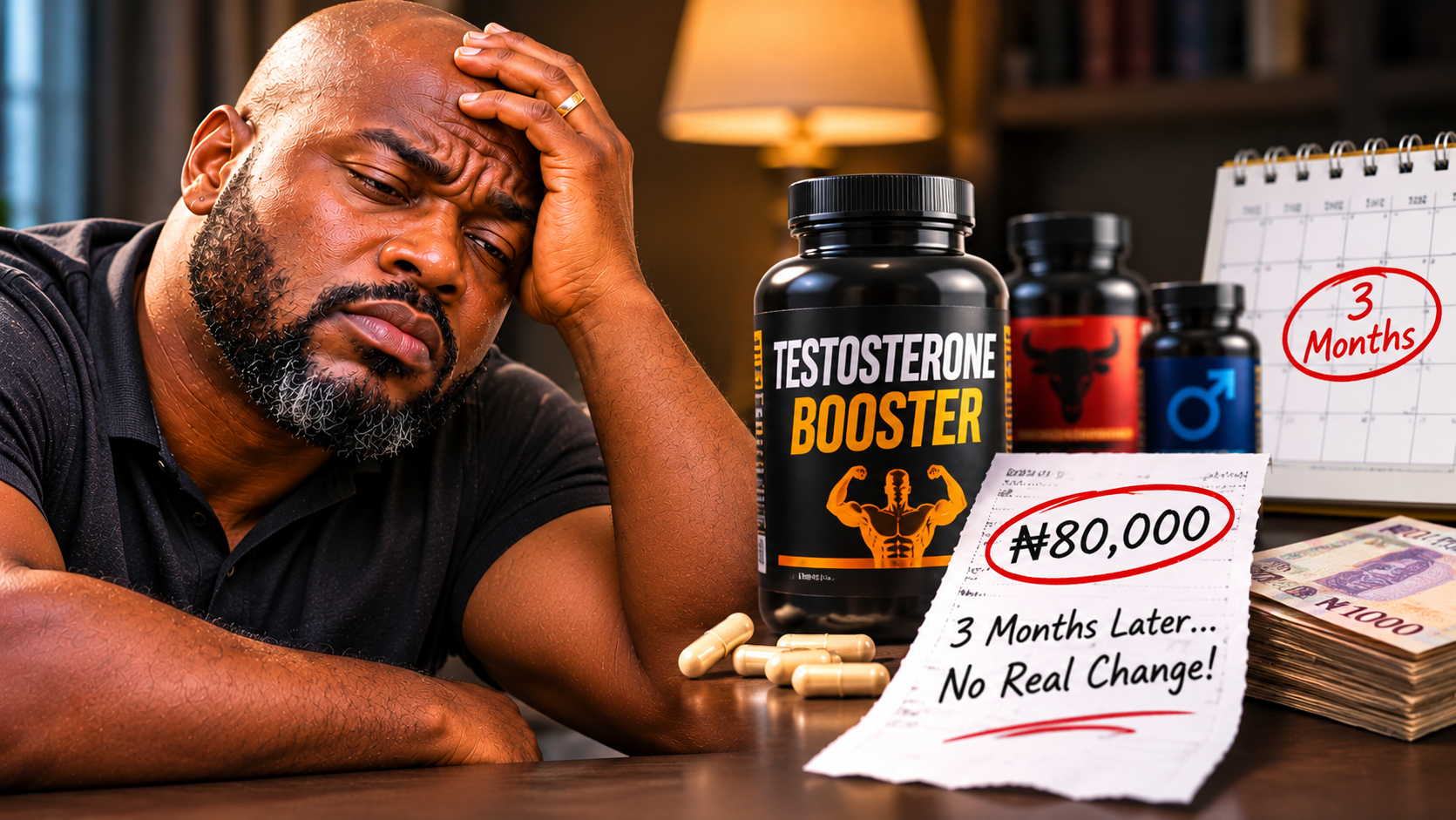
The vast majority are running on a system problem that no booster can reach. Men spend ₦50,000, ₦80,000, sometimes more — and three months later, nothing has changed except their bank balance. The ads sell hope. They don’t sell results.
Look at the system, not the night.
The bedroom is not where the problem started. It’s just where you finally noticed it. The fix isn’t in the bedroom either. It’s in the ordinary, invisible machinery of your body — the way it sleeps, hydrates, moves, eats, and recovers. That’s the answer I wrote back to Emeka. And the reason it worked, and the reason the other three never could, is what the rest of this article is about.
04 The System Nobody Explains
Circulation. But not the version you’ve heard.
What Emeka was actually dealing with is a system most men can name but can’t explain. It isn’t hormones. It isn’t “manhood.” It’s what sits inside every blood vessel he owns.
Your vessels are lined with a thin layer of cells called the endothelium. Think of it as a signalling sheet. When your body needs blood somewhere, this sheet releases a gas called nitric oxide. That gas is the message that tells the muscles in your vessel walls to open wide.
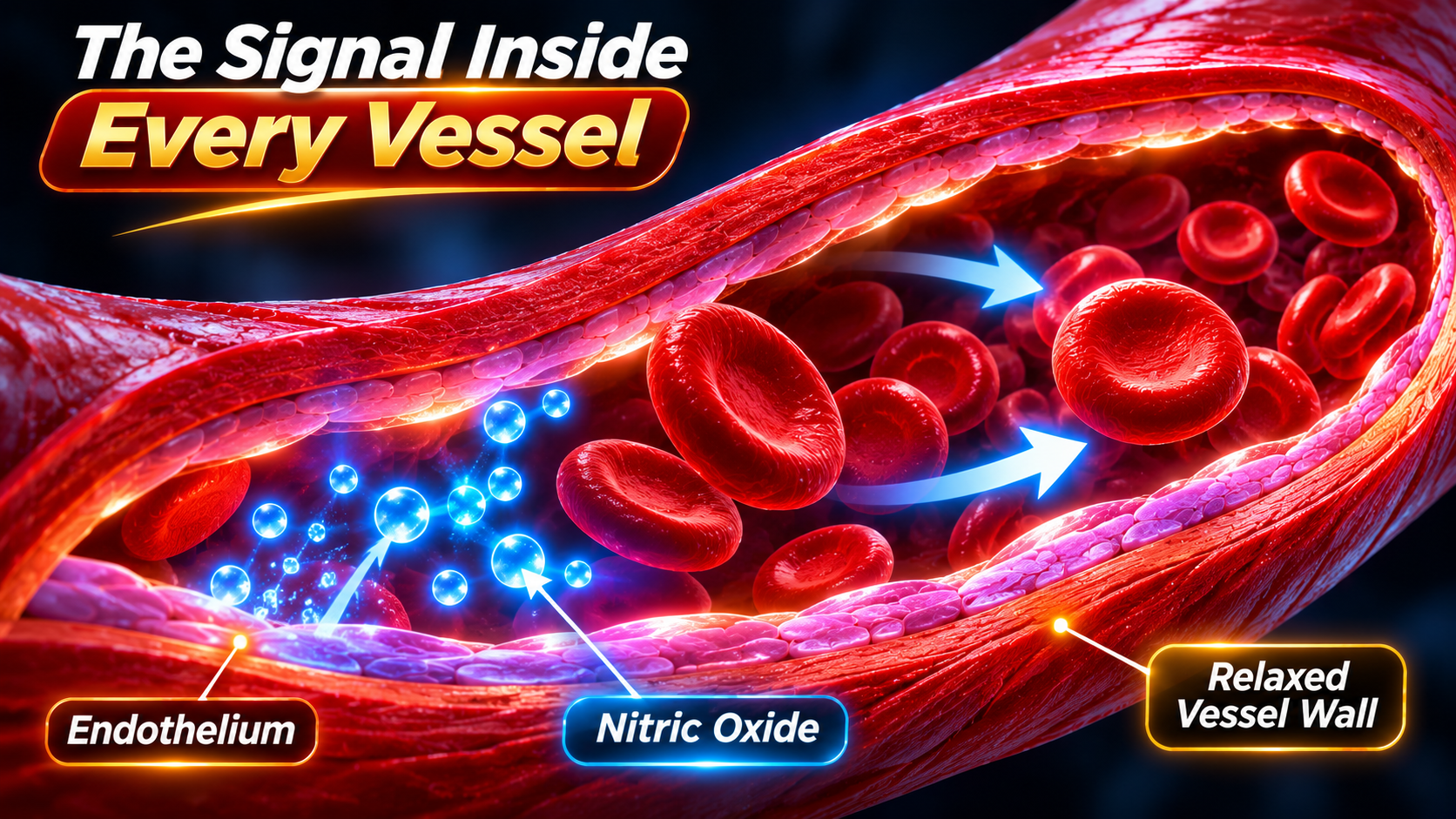
When nitric oxide flows properly, blood flows properly. Organs get oxygen. Your brain stays sharp. Your energy stays steady. And your vascular system performs the way it’s supposed to — everywhere in the body, including the places a man doesn’t like to think about out loud.
Healthy nitric oxide keeps vessels relaxed. When the endothelium is unhealthy, vessels narrow and flow drops.
When the endothelium gets damaged — by stress, poor sleep, dehydration, processed food, or too much sitting — nitric oxide production drops. Vessels narrow. Flow reduces. You feel it as tiredness by 3 PM, fog by evening, and low drive by night.
And here’s the part almost no man learns until too late: the vessels that matter for bedroom performance are among the smallest in the body. They can show strain years before your heart, your brain, or your blood pressure does. Which means if you’ve been quietly frustrated at night, you may have been given an early warning sign of a cardiovascular problem that hasn’t announced itself yet.
A fact worth knowing: Many urologists now treat persistent bedroom difficulty as a possible early indicator of cardiovascular disease — sometimes years before a heart event. That’s not meant to scare you. It’s meant to tell you that this is not a “bedroom issue.” It’s a whole-body signal, and you’re standing in the window where you can still do something about it.
Skeptical? Good. Don’t believe me — check me.
Every claim in this article is something you can verify yourself in five minutes. Here are three, and exactly what to search.
Search: Nobel Prize 1998 nitric oxide
Search: erectile dysfunction early marker cardiovascular disease
Search: FDA tainted sexual enhancement products
05 The Five Things Quietly Draining You
You’re probably doing all five.
Emeka’s problem wasn’t exotic. Yours probably isn’t either. When I went back through his last six months with him by email, all five of the following applied. Odds are they apply to you too.
- Sleep that looks sufficient but isn’t.Seven hours in a hot room next to a humming generator, with WhatsApp buzzing on your pillow, is not seven hours of recovery. Most men have none of the four conditions the body actually needs — cool, dark, quiet, unbroken.
- The afternoon blood-sugar whiplash.White bread, sweet tea, a meat pie at 11. That pattern spikes insulin and sets you up for the crash you feel at 3 PM. It’s not a coincidence.
- The ten-hour sit.Long stretches of sitting reduce circulation to the lower body — even in gym-going men. What you do between 9 and 5 matters more than whether you exercise.
- Dehydration dressed as tiredness.Blood is mostly water. Mild dehydration makes blood flow slower and thicker. Most Nigerian men are mildly dehydrated most of the day and mistake it for fatigue.
- Background stress that never gets released.Traffic. NEPA. Family demands. Deadline anxiety. The body was never designed to run cortisol low-grade all day. Persistent stress directly suppresses nitric oxide production.
06 What Emeka Actually Did
The unimpressive fix that worked.
When Emeka wrote to me about his six weeks of trying everything, I replied with three questions. Just three. Not about the bedroom. Not about testosterone. Not about supplements.
(1) How hot is your bedroom at night? (2) Where does your phone sleep? (3) What does your last meal of the day look like?
His answers were the answers most Nigerian men give. The bedroom was hot — windows shut tight against mosquitoes, no fan, or a fan that’s barely working. The phone was on the bedside table, face-up, glowing all night. Dinner was heavy — a plate of swallow or rice — eaten around 9:30 PM.

I said: your problem is probably not your “manliness.” It’s that your body has been running for years without proper overnight recovery. Overnight is when the male body does much of its most important vascular and hormonal repair work. Emeka had been sleeping hot, waking up four or five times a night to pings, and eating his biggest meal right when that repair was supposed to begin. His body hadn’t been failing at “being a man.” It had been failing at “sleeping like one.”
Six weeks later, he had:
- Moved his phone to the hallway. Not silent. Not face-down. The hallway.
- Bought a ₦15,000 rechargeable fan. Bedroom kept cool and dark from 10 PM.
- Eaten his last meal by 8 PM. Light dinner — protein, vegetables — not swallow.
- Started drinking two litres of water before noon. Real water. Not tea.
- Walked 20 minutes once a day. After lunch, outside, in office clothes.
That’s it. That was the whole fix. No bottle. No import. No subscription. And here’s what happened over six weeks: morning erections came back in about three. Energy came back by week five. By week six, he wrote me the sentence that still sticks with me.
“I don’t feel like I have to prove anything to my wife anymore. I just feel like myself.”
Let me be careful with this story, because it could easily be misread. Emeka’s fix worked for Emeka’s problem. But the kind of problem — the shape of it — is what I see in almost every reader who writes to me. The specifics vary. The mechanism is almost always the same: the body’s overnight repair system is failing, and it’s failing because the inputs are wrong. That’s the layer none of the four wrong answers could reach.
07 What I’ve Kept Back
And why I’m telling you it exists.
This is the part where most articles like this one turn into a pitch. I don’t want to be that article. So instead, I want to just tell you plainly what’s underneath what you’ve read.
The five changes I wrote back to Emeka about — sleep, water, food timing, movement, stress — those are the foundation. If you fix them, you’ll likely feel a real difference within a couple of weeks. If you only ever did these five things, you would be better off than most men reading this article.

But there is a second layer on top of the foundation. It’s the specific measured combinations of local ingredients, the timing rules, and the safety pairings that build on what the foundation does. Roughly eleven recipes. Roughly the size of a small cookbook. Men who have tried them properly report feeling the difference in about ten to fourteen days — earlier morning energy, better staying power, sharper focus by afternoon.
I’ve kept that second layer out of this article. Not because I’m hiding some secret. Because the specific combinations and timings don’t help if they’re taken out of context. They need the foundation underneath them. They need the safety warnings. They need to be done in order. A man who jumps straight to the recipes without the foundation underneath is the man who ends up with an unlabeled bottle problem all over again.
Something small, reserved for readers
For the men who actually download the brief this week — and actually read it, not skim it — I’ve put together a follow-up chapter. It’s about 600 words. It’s not in the main brief. It’s not published anywhere. It’s not for sale.
It walks through the three signs most men miss — the ones that show up years before the problem you feel today. It started as the email I kept sending back to newsletter readers who wrote in. I’ve only ever put it in writing for the readers of this brief.
When your email arrives, there’s a link in the second message called “Read This Second.” That’s the chapter. It’s yours if you want it. Nobody else sees it.
And yes — if the follow-up chapter makes you want to go further, there’s an invitation on the page after that one. It’s the second layer I mentioned above — the eleven measured recipes, the timing rules, the safety notes, the whole thing, offered only to readers of this brief. But that’s further down the road. Take the first step. The rest will be there when you want it.
08 The Free Brief
What I want to send you.
I’ve written the whole explainer down properly. It’s called The Natural Arterial Circulation Research Brief. Ten pages, plain English, no medical jargon. It covers:
- The five daily things choking your circulationPlain-English detail on each, and how they compound together.
- The truth about unlabeled local bittersWhat testing of unregulated herbal products keeps finding, and why it matters for your kidneys and liver.
- The blue pill trapThe difference between the pharmacy version and the kiosk version — plus the “hidden in herbal products” scam that quietly puts men at risk.
- Nine everyday market ingredients worth knowingSimple foods you can find in any Nigerian market, and what each one actually does, in one plain line.
- The 15-minute daily routineWhat to actually do tomorrow morning, not “in theory.”
- The seven medical red flagsThe signs that mean stop reading and see a doctor this week. Not from a supplement article — from what actually warrants medical attention.
And the “Read This Second” chapter I mentioned above comes with it — free, and only for readers of this brief.
I want to be clear about what this brief is not. It is not a pitch. It is not going to try to sell you a ₦300,000 course on the next page. It is what I wish someone had put into my hands in 2021, before I spent three years testing the wrong things.
Read the brief. Try the foundation for ten days. If nothing changes — close the tab. You’ve lost nothing, and I’m entirely comfortable with that.
Send Me The Free Brief
Your brief and the reader-only “Read This Second” chapter are sent to your email in under 60 seconds. Please use a valid email address you can open right now. No card, no cost, no catch.
For adult men 18+. Free PDF, sent by email only, so please enter a valid address. Unsubscribe anytime. By submitting, you agree to our Privacy Policy.
Before You Enter Your Details
Is this medical advice?
Is this a scam? What’s the catch?
What exactly is the “Read This Second” chapter?
Will you spam me? What happens to my data?
Is this safe if I’m on medication?
Is this only about bedroom performance?
How long is the brief, and how fast will I get it?
What if I’m under 18?

About the Author
Ola Carlos writes about men’s everyday wellness for Bangwell.ng — with an emphasis on honest explanation over quick fixes. He spent three years testing (and abandoning) the standard Nigerian herbal circuit before writing this brief, and now focuses on what actually works in the ordinary life of the ordinary Nigerian man.
One Last Thing.
If you’re still reading, it’s because something in this article described your morning, or your evening, or the way you look at your body when nobody’s watching.
That feeling isn’t going to go away by itself. You already know that — you’ve known it for months. So here’s what I would ask of you: let me send the brief. Read it in a quiet hour this week. Try the foundation for ten days. If nothing changes — close the tab, you’ve lost nothing. If something does change — you’ll finally know what you’re actually working with.
Get The Free Brief + Bonus Chapter
Ten-page brief. Reader-only follow-up chapter. Sent to your email. No card, no cost, no catch.
Yes — Take Me To The Free Brief ↑For adult men 18+. We never share your info. One-click unsubscribe. See our Privacy Policy.
— Ola Carlos